
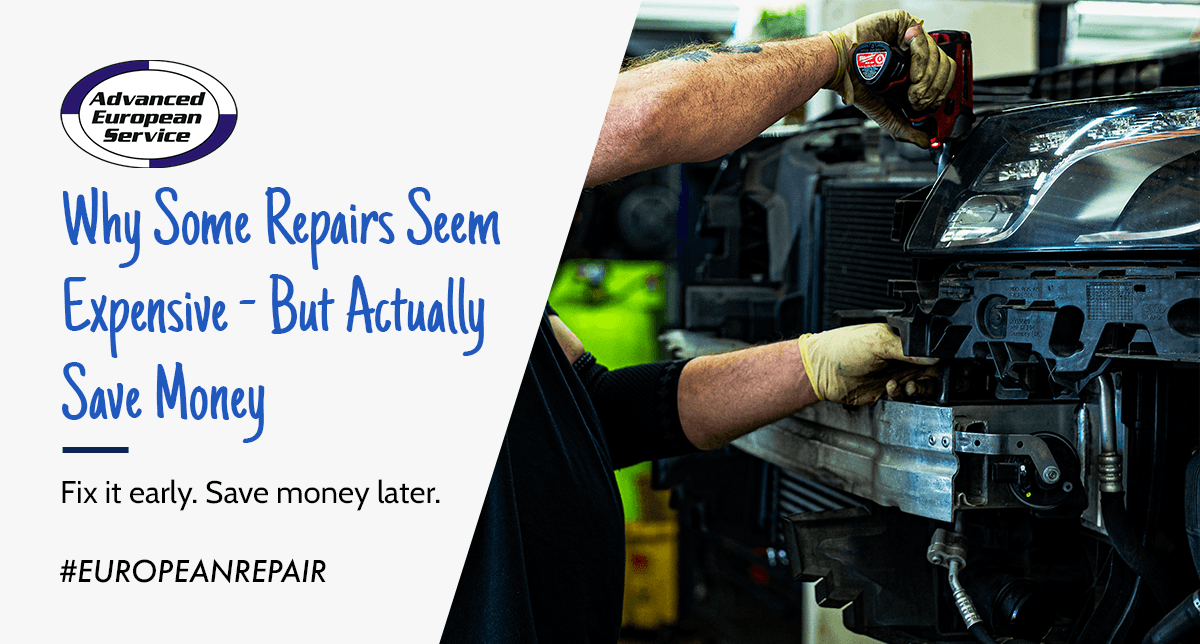
Nobody enjoys receiving a large repair estimate.
Whether it’s a cooling system overhaul, suspension work, or timing system repair, the initial number can feel overwhelming. It’s natural to compare prices, question recommendations, or wonder whether the repair can wait a little longer.
At Advanced European Service, we understand that reaction completely.
What we’ve learned over the years, however, is that some of the repairs owners hesitate to approve are actually the ones that save the most money in the long run.
The reason is simple.
European vehicles are engineered as integrated systems.
Very few components fail in complete isolation. One worn part often affects the performance and longevity of several others.
Take a cooling system as an example.
A small coolant leak may seem insignificant today. But if it causes the engine to overheat, the repair no longer involves a hose or water pump. It can involve cylinder head damage, warped components, or extensive engine work.
The repair became expensive not because of the original failure—but because of the delay.
The same principle applies throughout modern European vehicles.
A worn suspension bushing changes wheel alignment, which accelerates tire wear.
Weak ignition coils increase stress on catalytic converters.
Failing engine mounts place additional load on exhaust components and drivetrain connections.
Small problems rarely remain small.
This is why some repair estimates appear expensive.
They’re often addressing issues before they begin affecting surrounding systems.
Another factor owners sometimes overlook is labor efficiency.
Certain repairs require accessing areas of the vehicle that are already disassembled during related work. Performing those services together often reduces total labor costs compared to doing them separately months later.
Planning repairs strategically frequently lowers overall ownership cost.
At Advanced European Service, we also believe in explaining the “why” behind every recommendation.
Our goal isn’t simply presenting an estimate.
It’s helping owners understand the long-term consequences of delaying—or approving—that repair.
When customers understand the engineering behind the recommendation, the conversation shifts from price to value.
That’s an important distinction.
The cheapest repair isn’t always the one with the lowest invoice.
It’s often the one that prevents a much larger repair later.
Because in European vehicle ownership, timing matters almost as much as the repair itself.