
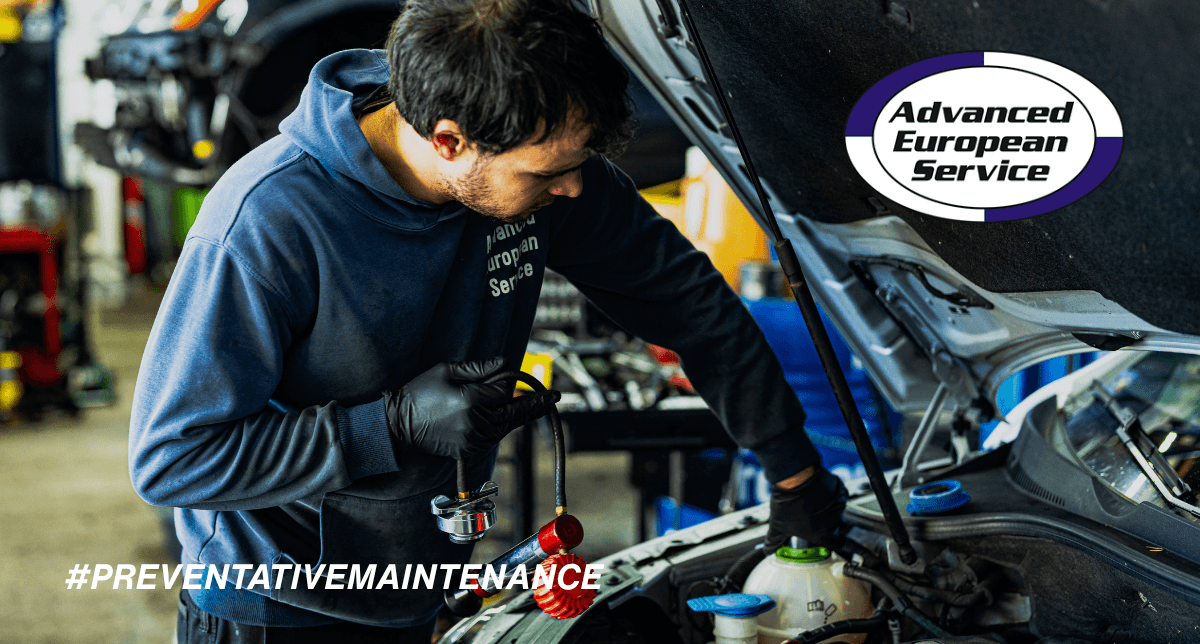
Most expensive repairs don’t begin as major failures. They begin as small, manageable issues that were overlooked, delayed, or misunderstood. By the time a vehicle arrives with a serious problem, the root cause often traces back to something that could have been addressed much earlier.
At Advanced European Service, preventative maintenance isn’t just about keeping a car running — it’s about protecting it from becoming expensive to own.
European vehicles are engineered with precision. Tight tolerances, high operating temperatures, and integrated systems mean that small deviations have a larger impact than they might in simpler vehicles. When a fluid begins to degrade or a component starts to wear, the system adapts for a while. But that adaptation has limits.
A cooling system that is slightly underperforming may not trigger a warning immediately. Over time, however, temperature fluctuations begin to affect surrounding components. Plastic housings weaken, seals begin to degrade, and eventually the system fails in a way that feels sudden — even though it wasn’t.
The same pattern applies to oil maintenance. Oil doesn’t fail instantly; it breaks down gradually. As it loses its ability to lubricate and protect, internal engine components begin to experience increased friction. Timing systems become stressed, turbochargers operate under less protection, and carbon buildup accelerates.
By the time symptoms are noticeable, wear has already occurred.
Preventative maintenance interrupts this cycle. It replaces degradation with consistency.
Brake fluid is a simple example. Over time, it absorbs moisture from the air. That moisture lowers its boiling point, affecting braking performance under load. Flushing brake fluid at the correct interval restores its effectiveness and protects internal components from corrosion.
Transmission servicing follows a similar principle. Fluid that appears functional may no longer provide optimal lubrication or pressure control. Servicing it before symptoms appear prevents internal wear that cannot be reversed.
One of the most overlooked aspects of preventative maintenance is predictability. When maintenance is planned, costs are distributed over time. When maintenance is deferred, costs tend to arrive all at once.
A vehicle that receives consistent care rarely presents multiple major repairs simultaneously. A vehicle that has been neglected often does.
This is where preventative maintenance becomes not just mechanical protection, but financial strategy.
There is also a confidence factor. A well-maintained European vehicle behaves consistently. It starts the same way, drives the same way, and responds the same way every time. That predictability reduces stress and increases enjoyment.
Owners who follow preventative maintenance rarely describe their vehicles as “unreliable.” Instead, they describe them as responsive and dependable.
At Advanced European Service, the goal of maintenance is not to prevent every possible issue — that’s unrealistic. The goal is to prevent avoidable ones, which are often the most expensive and disruptive.
Because in most cases, the difference between a manageable service and a costly repair is timing.
Preventative maintenance is simply choosing to act before the vehicle forces the decision.