
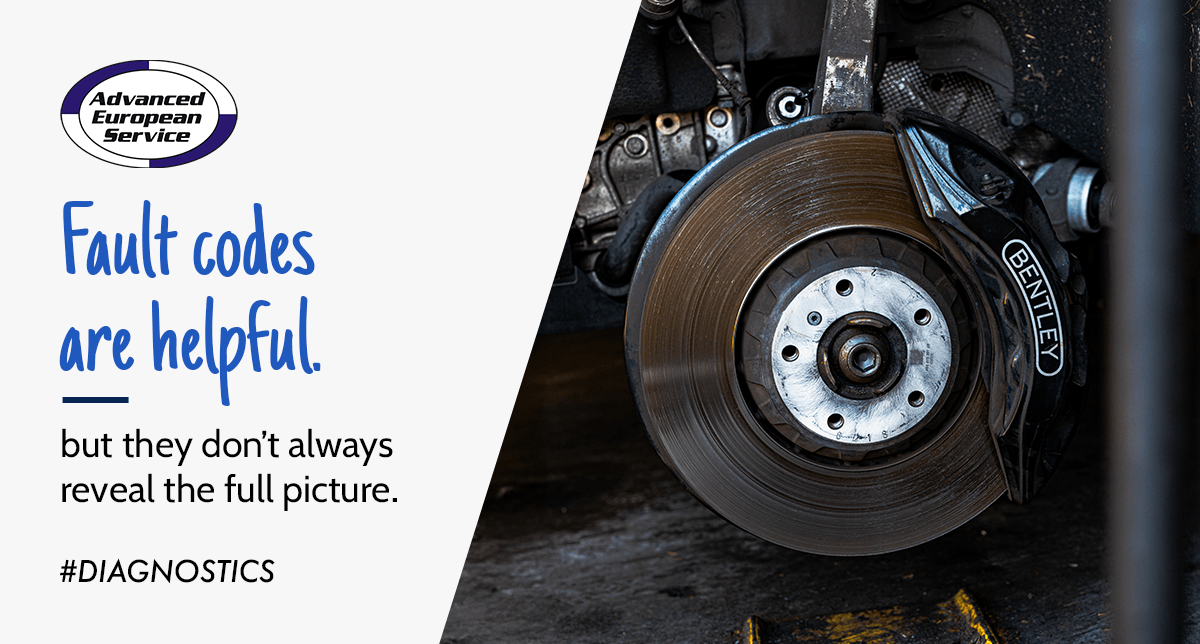
One of the biggest misconceptions in modern vehicle diagnostics is the belief that fault codes tell the entire story.
They don’t.
At Advanced European Service, fault codes are only the starting point. The real insight often comes from something far more important: live data.
Modern European vehicles generate enormous amounts of information while they operate. Sensors continuously monitor airflow, fuel delivery, ignition timing, boost pressure, temperature behavior, emissions performance, and dozens of other variables in real time.
Fault codes only appear when one of those values moves outside a programmed threshold for a specific amount of time.
But long before that happens, live data usually reveals subtle changes that indicate the beginning of a problem.
That distinction matters because many developing issues don’t trigger warning lights immediately. A sensor may still function, but respond slower than normal. Fuel trims may begin compensating slightly more than expected. Boost pressure may fluctuate under load without exceeding the limits required to store a fault.
The vehicle adapts, and the driver notices nothing unusual.
But live data tells a different story.
This is where proper diagnostics separate reactive repair from proactive diagnosis.
At Advanced European Service, we use live operating data to evaluate how systems behave under real driving conditions. We look at airflow consistency, ignition correction behavior, boost response, fuel trim movement, sensor reaction times, and thermal patterns while the vehicle is running.
These details reveal system health in ways fault codes alone cannot.
For example, a vehicle may not display a check engine light, but live data may show fuel corrections increasing steadily over time. That could indicate the early stages of an airflow issue, injector imbalance, or developing vacuum leak long before drivability symptoms become obvious.
The same applies to turbocharged vehicles. Requested boost pressure may appear normal on paper, but live readings may reveal delayed response or inconsistent delivery under acceleration. Those patterns often identify developing issues before performance noticeably declines.
This approach allows problems to be identified earlier, when repairs are usually smaller, less expensive, and less likely to affect surrounding systems.
It also prevents unnecessary parts replacement.
One of the most common causes of misdiagnosis is relying too heavily on stored codes without evaluating real-time behavior. A code identifies where the system detected irregularity — not necessarily what caused it. Live data provides the context needed to interpret those codes correctly.
Modern European vehicles are incredibly intelligent, but understanding them requires more than reading fault memory. It requires understanding how the systems behave while the vehicle is actually operating.
That’s why live data has become one of the most valuable tools in modern European diagnostics.
Because the vehicle often reveals the problem long before it officially reports it.