
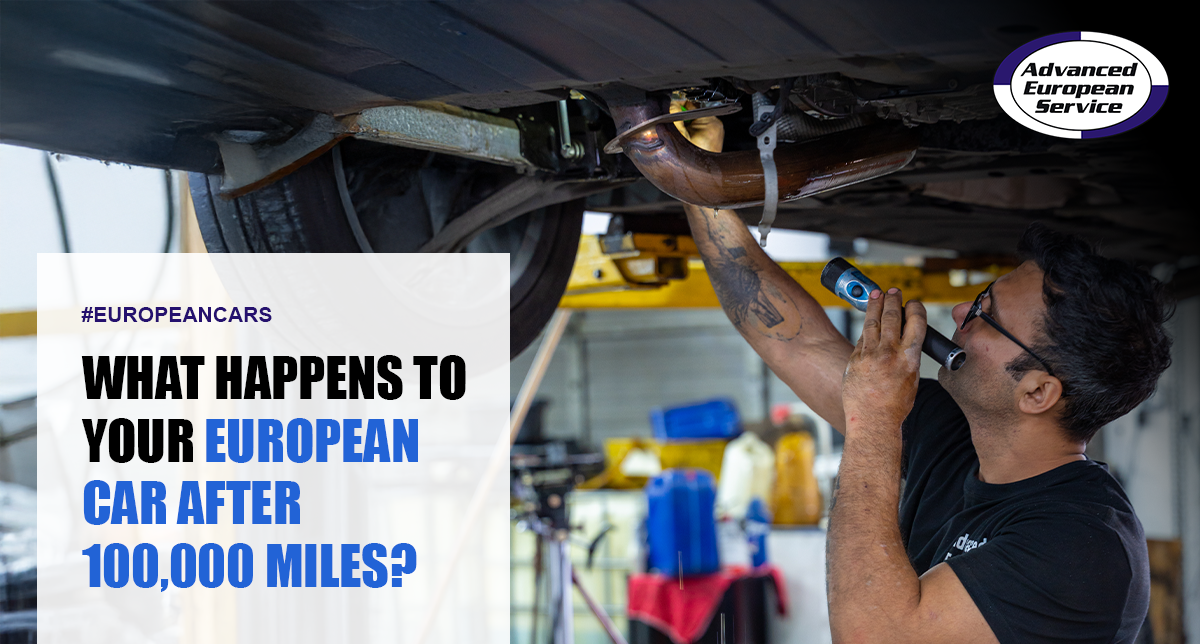
There was a time when 100,000 miles felt like a major milestone in a vehicle’s life. For many owners, reaching six figures on the odometer meant it was time to start thinking about replacing the car before expensive problems began.
Modern European vehicles have changed that conversation.
A properly maintained BMW, Audi, Mercedes-Benz, Volkswagen, Volvo, Land Rover, Jaguar, or MINI can have plenty of life remaining after 100,000 miles. But there is an important distinction between a European vehicle that has simply reached 100,000 miles and one that has been properly maintained for 100,000 miles.
At Advanced European Service, that difference becomes obvious very quickly.
Mileage itself doesn’t suddenly cause a vehicle to deteriorate. There isn’t a mechanical switch that flips when the odometer reaches six figures. What changes is the accumulation of thousands of heat cycles, cold starts, miles of suspension movement, transmission shifts, braking events, and hours of engine operation.
By 100,000 miles, maintenance history begins to matter more than the number on the dashboard.
A vehicle that has received consistent oil services with the correct fluids, timely cooling system maintenance, proper transmission care, and attention to developing leaks and worn components can still feel remarkably tight and refined.
A neglected vehicle with the same mileage can feel completely different.
One of the areas we pay close attention to as mileage increases is the cooling system. European engines operate within carefully controlled temperature ranges, and components such as water pumps, thermostats, hoses, reservoirs, seals, and plastic fittings experience repeated heat cycles throughout the vehicle’s life.
The same is true of suspension and steering components. Bushings, control arms, mounts, and other wear items may gradually lose the precision they once had. The vehicle may still drive perfectly well, but steering response and ride quality can slowly change without the owner noticing.
Engine and transmission conditions also deserve closer attention.
Modern turbocharged European engines place significant demands on lubrication, cooling, and airflow systems. By 100,000 miles, small oil or coolant leaks, aging ignition components, carbon buildup, and worn engine mounts may begin influencing how the vehicle performs.
None of these automatically mean the vehicle is becoming unreliable.
They mean the maintenance strategy needs to evolve.
One mistake owners sometimes make is becoming less willing to maintain the vehicle because it has higher mileage. They start thinking, “It’s an older car, so I don’t want to put money into it.”
Ironically, this is often when thoughtful maintenance becomes most valuable.
A well-maintained European vehicle that you already know can sometimes be a far better financial decision than replacing it with another used vehicle with an unknown history. The key is understanding the vehicle’s overall condition and prioritizing repairs intelligently.
At Advanced European Service, we don’t believe 100,000 miles should automatically be treated as the beginning of the end.
We treat it as a point where experience, inspection, and planning become increasingly important.
If the engine is healthy, the transmission is operating properly, the structure is sound, and the vehicle has been cared for consistently, there may be many enjoyable miles ahead.
European vehicles are built to deliver performance and refinement for the long term.
The odometer tells you how far the car has travelled.
Its maintenance history tells you how much life it may still have left.