
Walk through the parking lot at any shopping centre and you’ll probably see two European vehicles sitting side by side. They may be the same make, the same model, and even the same year. On the surface, they look almost identical.
But if you drove both vehicles back-to-back, you would likely notice something very different.
One feels tight, responsive, and refined. The steering is precise, the engine responds instantly, the transmission shifts smoothly, and the cabin remains quiet and composed.
The other still gets from point A to point B, but something feels different. The steering may be less precise, acceleration slightly slower, vibrations more noticeable, and the entire vehicle just feels older than it should.
The difference often isn’t age.
It’s maintenance.
At Advanced European Service, we’ve worked on thousands of European vehicles over the years, and one thing has become remarkably clear: properly maintained European vehicles age very differently than neglected ones.
The reason comes down to how these vehicles are engineered.
European manufacturers build their vehicles with extremely tight tolerances. Every component is designed to operate within a very specific range. Engine performance depends on clean oil and precise fuel delivery. Suspension geometry relies on bushings and joints remaining within design specifications. Transmission performance depends on healthy fluid and accurate adaptations.
When maintenance is performed consistently, those systems continue working together as intended.
When maintenance is delayed, each system begins to drift slightly away from its optimal condition.
At first, the changes are almost impossible to notice.
Engine oil slowly loses its protective properties. Suspension bushings soften over thousands of miles. Brake fluid absorbs moisture. Cooling system components experience repeated heat cycles. Ignition components wear gradually.
None of these changes create immediate failure.
Instead, they create gradual decline.
Because the process is so slow, most owners simply adapt to the vehicle’s changing behaviour.
Until they drive another well-maintained example of the same model.
That’s often when they realise how much their own vehicle has changed.
One of the biggest misconceptions about vehicle ownership is that maintenance is simply about preventing breakdowns.
While that’s certainly part of it, regular maintenance does something much more important—it preserves the character of the vehicle.
European vehicles are designed to deliver a very specific driving experience. The steering should feel connected without being heavy. The suspension should feel composed without being harsh. The engine should deliver smooth, predictable power across the rev range.
When maintenance is neglected, that balance slowly disappears.
The vehicle still works.
It simply no longer feels exceptional.
This is why proactive ownership consistently costs less over the life of the vehicle.
Small services performed at the right time prevent larger repairs later. More importantly, they preserve the qualities that make European vehicles enjoyable to drive in the first place.
At Advanced European Service, our goal isn’t simply to repair what’s broken.
It’s to help owners preserve the driving experience they invested in when they chose a European vehicle.
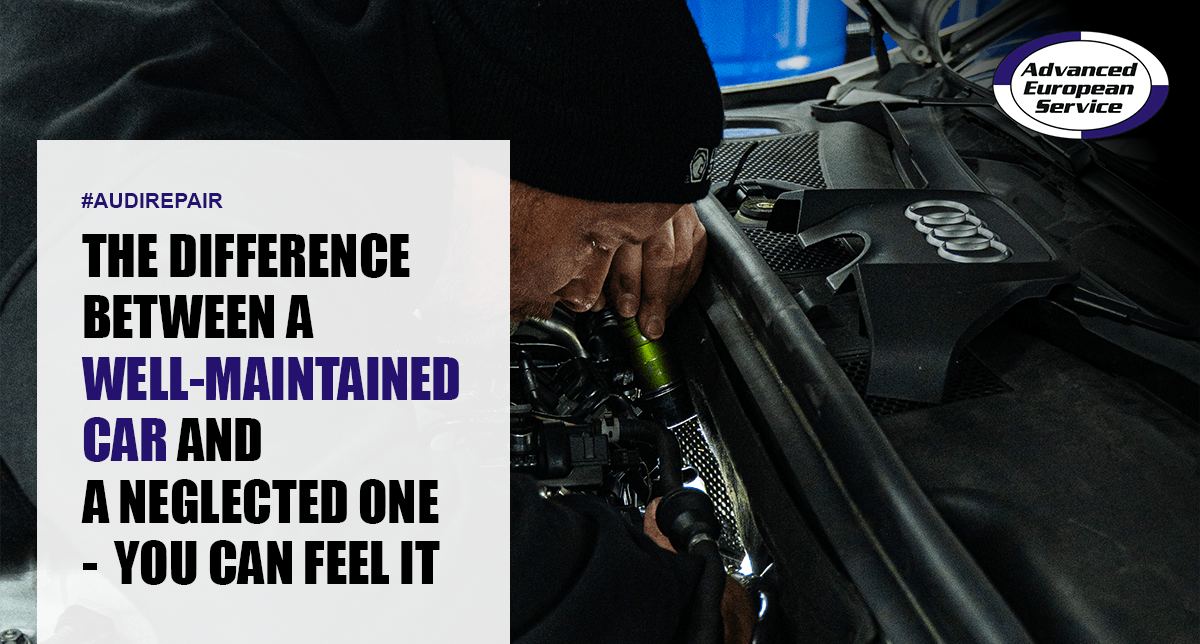
Because the difference between a well-maintained car and a neglected one isn’t always something you can see.
But it’s almost always something you can feel the moment you get behind the wheel.
And once you’ve experienced the difference, it’s impossible to ignore.