
Most drivers assume that if there are no warning lights on the dashboard, everything must be working correctly. And to be fair, modern vehicles are designed to create that confidence. They start smoothly, drive comfortably, and compensate for small irregularities so effectively that many developing problems go unnoticed.
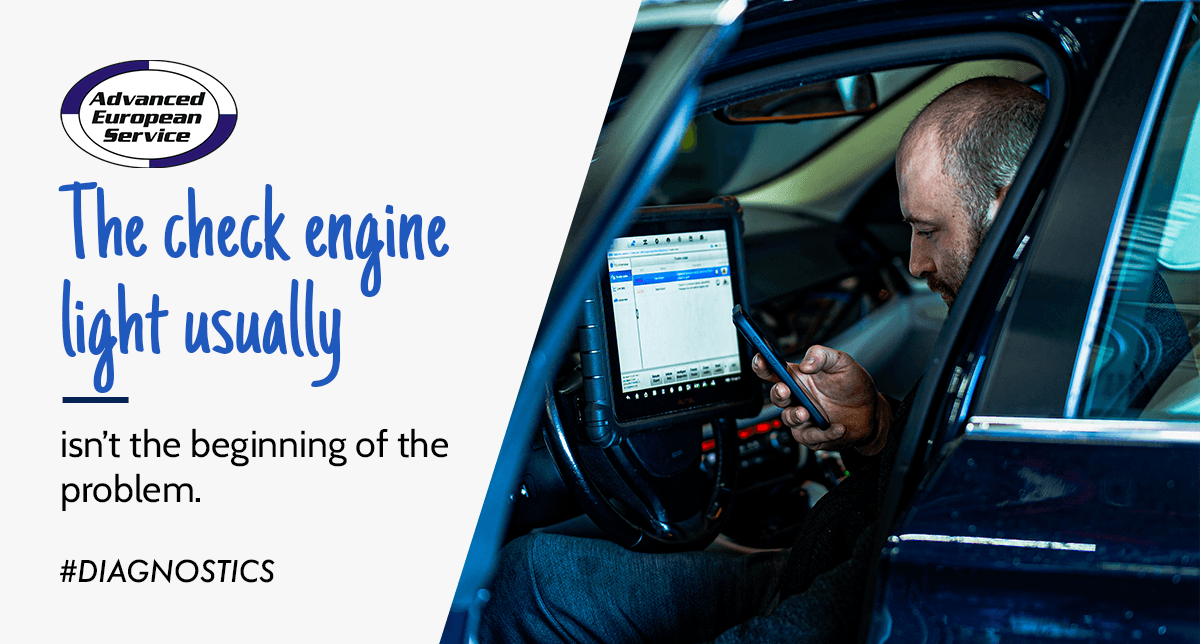
But at Advanced European Service, we know that the check engine light is usually not the beginning of a problem — it’s the point where the vehicle can no longer hide it.
Modern European vehicles constantly monitor themselves. Fuel delivery, airflow, ignition timing, boost pressure, emissions efficiency, cooling performance — every major system generates data continuously while the vehicle is operating. The engine management system compares those values against expected operating ranges thousands of times every second.
What most drivers don’t realize is that problems often begin long before those values cross the threshold required to trigger a warning light.
A sensor may start responding slower than normal. Fuel trims may begin drifting slightly outside ideal balance. Boost pressure may fluctuate subtly under acceleration. Ignition timing may compensate for combustion irregularities that are too small for the driver to notice.
Individually, these changes may seem insignificant. But together, they create patterns.
And those patterns are where early diagnosis begins.
At Advanced European Service, one of the biggest differences in our diagnostic process is that we don’t rely solely on fault codes. Fault codes are useful, but they only tell part of the story. They identify when the vehicle has recognized a condition serious enough to store an error.
We focus on identifying the changes that happen before that point.
That means evaluating live data while the vehicle is operating under real conditions. We analyze airflow consistency, fuel correction behavior, ignition stability, boost response, temperature trends, and sensor reaction times. These details reveal how efficiently the systems are functioning — even when no warning lights are present.
This approach allows us to identify developing issues much earlier than reactive diagnosis alone.
In many cases, catching these problems early prevents significantly larger repairs later. A small ignition irregularity identified early may prevent catalytic converter damage. Detecting cooling system inefficiency before overheating occurs can protect the engine from severe stress. Identifying airflow imbalance early can prevent turbocharger strain and excessive carbon buildup.
The earlier a problem is identified, the more isolated and manageable it usually is.
Modern European vehicles are incredibly intelligent, but their ability to adapt can also make issues harder for owners to recognize. The car may still feel smooth and responsive while hidden compensations are taking place behind the scenes.
That’s why preventative diagnostics matter so much.
At Advanced European Service, our goal is not just to repair failures — it’s to identify the conditions that lead to failure before they become expensive, disruptive problems.
Because by the time the dashboard asks for help, the issue has often been developing for much longer than most drivers realize.