
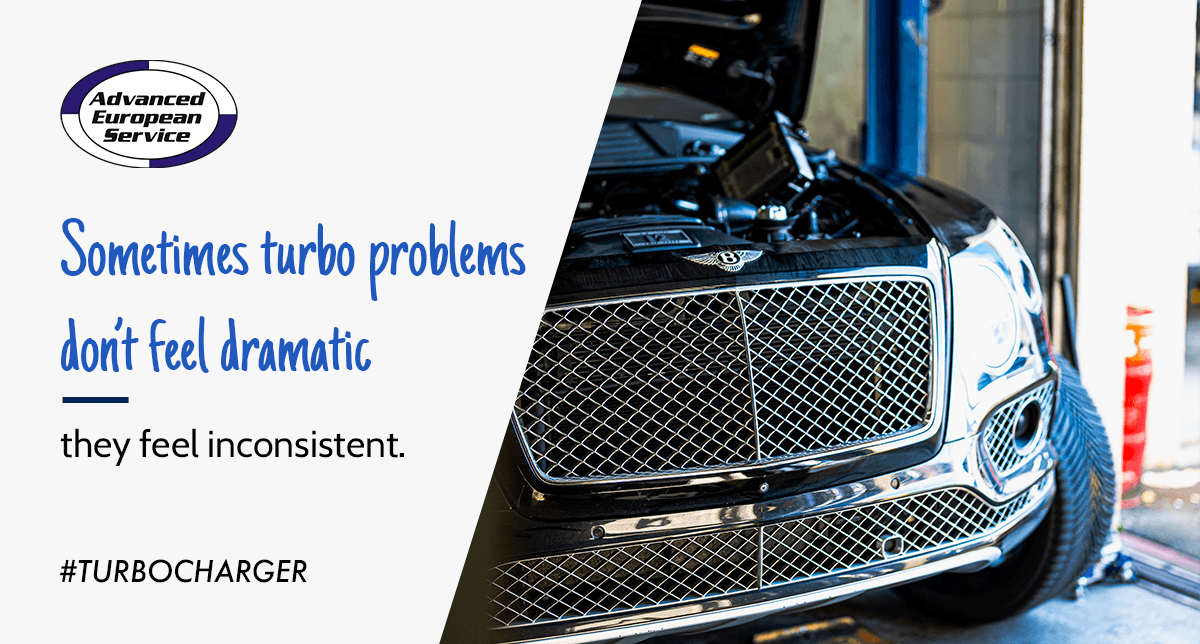
Turbocharged engines have become the backbone of modern European performance. Whether it’s a BMW accelerating onto the highway, an Audi building boost through a corner, or a Mercedes delivering smooth mid-range torque, turbocharging is what allows these vehicles to feel both powerful and refined at the same time.
But behind that smooth performance is a system operating under enormous heat and pressure. And within that system is a relatively small component that has a major influence on how the engine behaves: the wastegate.
At Advanced European Service, wastegate-related problems are something we see regularly on aging European turbo platforms. What makes these issues challenging is that they rarely begin with dramatic symptoms. Most of the time, the change is subtle enough that owners question whether anything is wrong at all.
The car may still feel fast. It may still drive smoothly. But something about the power delivery feels inconsistent.
That inconsistency is usually the first clue.
To understand why, it helps to understand what the wastegate actually does. A turbocharger works by using exhaust pressure to spin a turbine and generate boost. Without regulation, that pressure would continue building beyond safe operating limits. The wastegate controls this process by managing how much exhaust pressure reaches the turbocharger.
When the system is functioning properly, boost delivery feels smooth, predictable, and immediate. The driver never notices the regulation happening in the background.
Over time, however, the wastegate mechanism begins to wear. Internal linkages loosen, actuators lose precision, and carbon buildup affects movement. In some cases, the issue develops slowly enough that the engine management system compensates for it before the driver notices anything unusual.
That’s why early wastegate problems often feel vague rather than obvious.
Acceleration may become inconsistent under load. The car might feel stronger some days than others. Throttle response can feel softer, especially at higher RPM. Some drivers describe the sensation as the vehicle feeling “flat,” even though no warning lights are present.
Because modern European vehicles are highly adaptive, these symptoms are often masked temporarily through adjustments in boost control and fuel delivery. But compensation has limits. Eventually, the inconsistency becomes large enough that the vehicle can no longer maintain normal operation without triggering a fault.
That’s usually when warning lights appear.
One of the reasons wastegate problems are frequently misdiagnosed is because the symptoms overlap with other turbo-related issues. A failing wastegate can resemble a boost leak, an ignition problem, or even a fuel delivery issue. Replacing parts without confirming the root cause often leads to frustration and repeat visits.
This is why proper diagnosis matters so much.
At Advanced European Service, diagnosing turbo performance issues goes beyond scanning for fault codes. We analyze live boost behavior under load, evaluate wastegate response in real time, and compare requested boost pressure against actual system performance. This allows us to identify whether the issue is mechanical, electronic, or pressure-related before any repairs are recommended.
The goal is not simply to restore power. It’s to restore consistency.
Turbocharged European vehicles are engineered to feel effortless when everything is working correctly. When boost control becomes unstable, the driving experience changes long before catastrophic failure occurs. Identifying those changes early is what prevents a manageable repair from becoming a much larger one later.
Because with modern European performance systems, the vehicle usually tells you something is wrong long before it completely breaks.
You just have to know how to listen.