
One of the biggest misconceptions about owning a European vehicle is that maintenance costs are unpredictable.
In reality, most major expenses become unpredictable only when maintenance is reactive instead of planned.
At Advanced European Service, we’ve found that owners who approach maintenance strategically usually spend less over time — not because the vehicle requires less care, but because problems are addressed before they begin affecting multiple systems.
The key is understanding that European vehicles operate differently from many domestic platforms. They are engineered with tighter tolerances, more integrated systems, and higher performance expectations. That precision requires consistency.
But consistency doesn’t have to mean surprise expenses.
The first step in budgeting properly is separating maintenance from repair. Maintenance includes predictable services such as oil changes, brake fluid service, transmission servicing, cooling system inspections, and wear-item replacement. Repairs occur when developing issues are ignored long enough to create failure.
The owners who struggle most with European vehicle costs are usually not the ones maintaining their cars too much — they’re the ones postponing maintenance until repairs become unavoidable.
Another important factor is understanding service intervals realistically rather than emotionally. Many drivers delay maintenance because the vehicle still feels “fine.” But European vehicles are extremely good at compensating for developing wear. By the time drivability changes become noticeable, the issue has often progressed further than expected.
Budgeting becomes easier when maintenance is viewed as a schedule rather than a reaction.
At Advanced European Service, we often help owners create long-term maintenance plans based on mileage, vehicle age, driving habits, and platform-specific service patterns. This allows expenses to be anticipated gradually rather than arriving unexpectedly all at once.
Driving behavior also plays a larger role than many owners realize. Vehicles driven primarily on short trips, heavy traffic, or aggressive cold starts typically require more frequent maintenance than vehicles driven consistently under stable conditions.
Understanding how the vehicle is used helps create a more accurate ownership budget.
One of the biggest financial mistakes owners make is focusing only on immediate cost instead of long-term cost. Choosing lower-quality parts or delaying smaller services may reduce spending temporarily, but often increases overall ownership cost through repeat repairs or secondary damage later.
Well-maintained European vehicles are rarely unpredictable. In fact, they’re usually very consistent when serviced proactively.
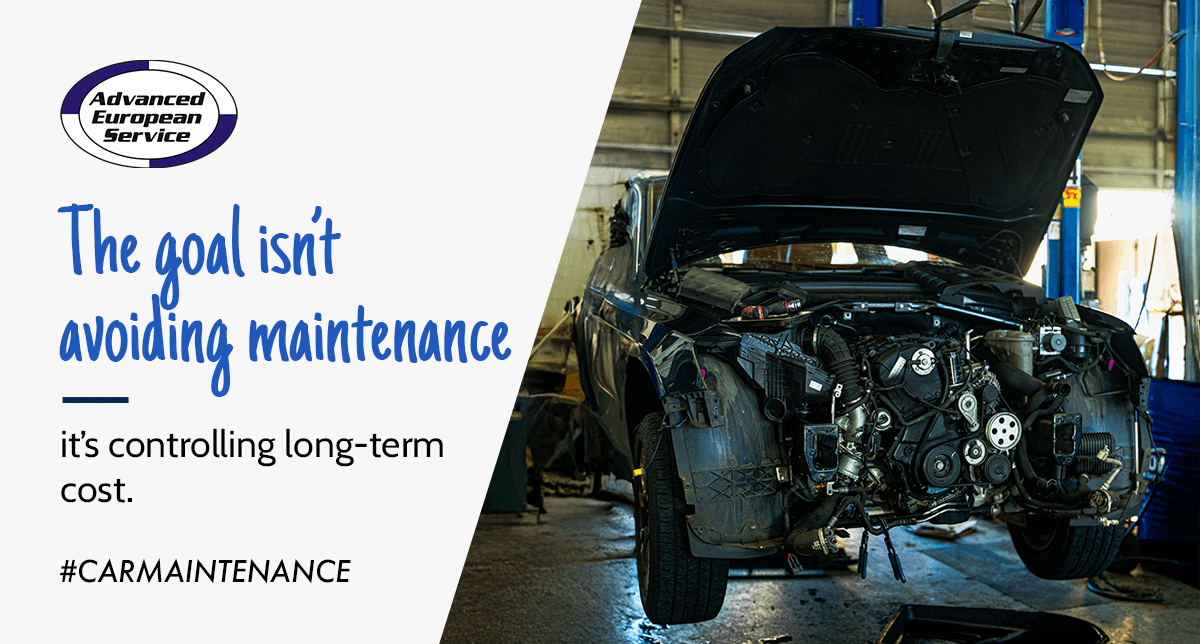
The goal isn’t to avoid spending money on maintenance. The goal is to control when and how that money is spent.
Because with European vehicles, the most affordable ownership experience usually comes from planning ahead — not catching up later.