
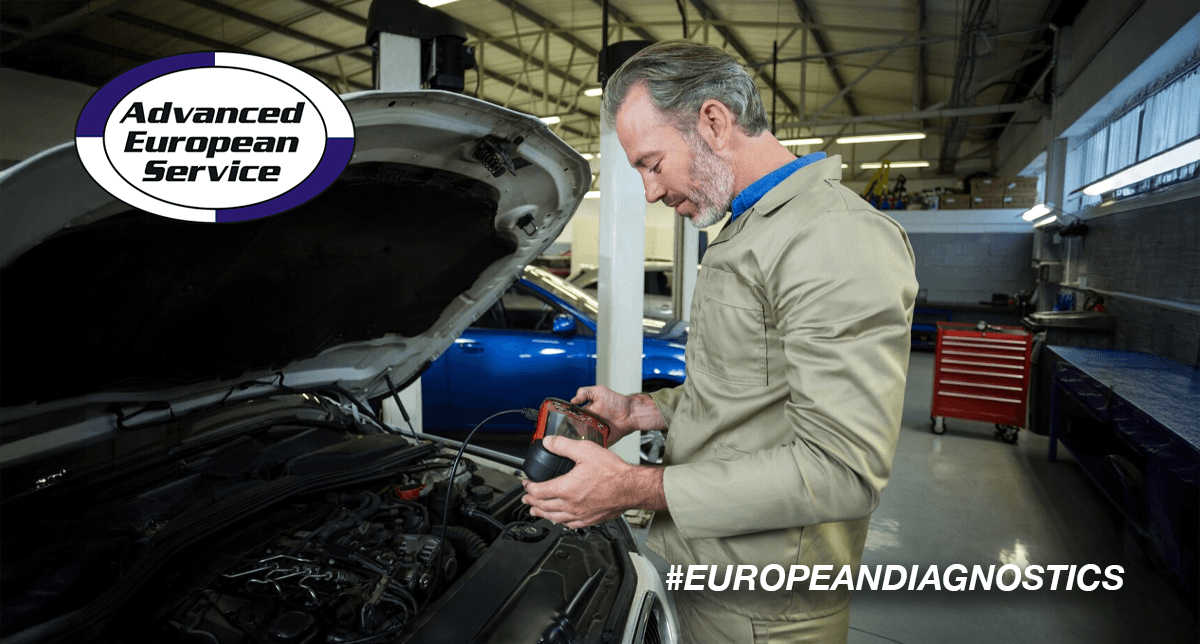
Modern European vehicles are not mechanical machines alone — they are digital ecosystems. Dozens of modules communicate constantly, exchanging data about engine load, braking force, steering angle, cabin comfort, and safety inputs. When one component behaves unexpectedly, the system reacts.
To the driver, that reaction appears as warning lights, alerts, or intermittent faults. To us, it appears as data.
At Advanced European Service, electrical diagnostics is not guesswork. It is a structured process designed to isolate cause before replacing parts.
Electrical problems rarely originate where they appear. A warning for a stability system may stem from voltage instability. A transmission fault may trace back to a sensor reporting inconsistent data. A cascade of dashboard lights may begin with a battery that is weak under load, even if it appears functional at rest.
The first step in every electrical diagnosis is power integrity. Without stable voltage, control modules cannot interpret signals correctly. Batteries, alternators, and grounding points are verified before deeper investigation begins. Skipping this step leads to unnecessary parts replacement.
Once voltage stability is confirmed, communication pathways are examined. European vehicles rely on network communication systems that allow modules to share data. If a module drops offline or reports irregular timing, other systems react. Understanding these communication patterns prevents misdiagnosis.
From there, live data becomes the focus.
Stored fault codes provide direction, but live data reveals behavior. Sensor signals are monitored under operating conditions. Load responses are evaluated. Patterns are compared against expected parameters. This reveals whether the issue lies in the sensor, wiring, control module, or mechanical system feeding the data.
Electrical diagnosis requires patience. Replacing a component because it is mentioned in a fault code is often incorrect. A code identifies the system detecting the irregularity—not necessarily the source.
After repair, recalibration is essential. Many European systems adapt to previous conditions. Without resetting adaptations and verifying communication, drivability issues can persist even after hardware is replaced.
Electrical repair without verification is incomplete.
Owners often arrive frustrated after repeated attempts elsewhere to “fix” a problem by swapping parts. Electrical systems reward process and punish assumptions.
The reality is this: modern European vehicles are logical. They report inconsistencies precisely. When approached systematically, electrical faults become traceable and resolvable.
At Advanced European Service, diagnosis is about clarity before action. It protects owners from unnecessary expense and ensures repairs address root causes rather than symptoms.
Electrical complexity does not require fear — it requires method.
And method prevents repeat visits.