
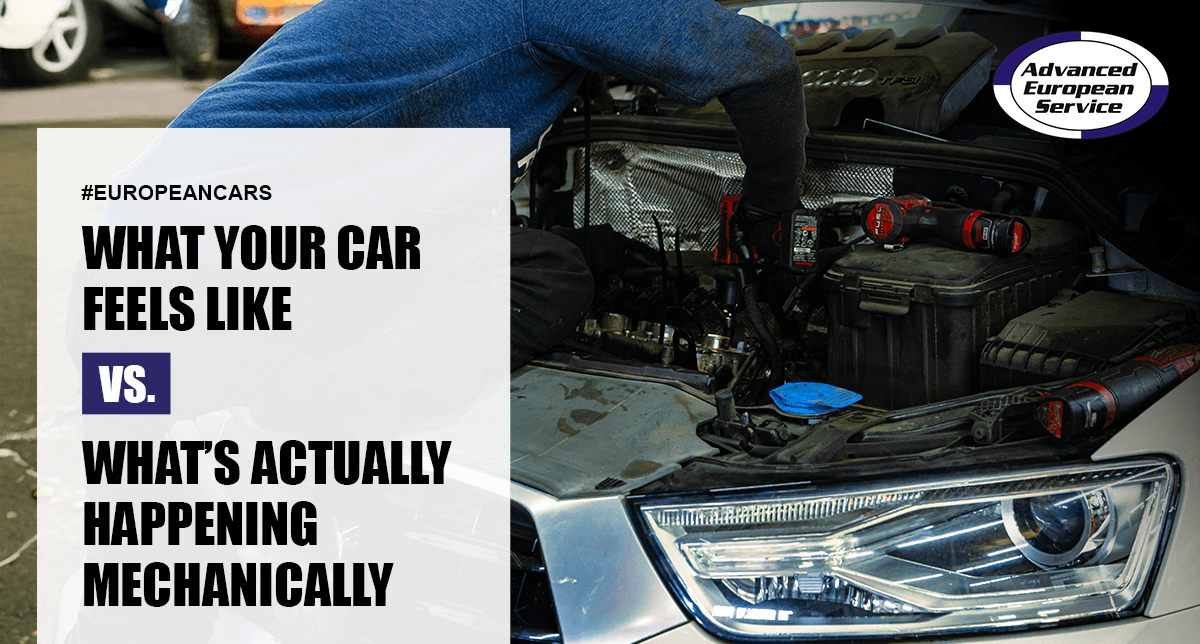
Every driver develops a relationship with their car.
You know how the steering feels on your favourite stretch of road. You recognise how quickly the engine responds when you press the accelerator. You become familiar with the sound of the engine, the way the transmission shifts, and even how the brakes respond in traffic.
Because of that familiarity, drivers often describe problems based on how the vehicle feels.
“It feels sluggish.”
“It feels rough.”
“It doesn’t feel as smooth as it used to.”
Those descriptions are incredibly valuable, but they rarely identify the actual problem. At Advanced European Service, we’ve learned that what a driver feels and what’s happening mechanically are often two very different things.
A European vehicle is made up of hundreds of components working together as one system. When one component begins to underperform, the effect is often felt somewhere else entirely.
Take acceleration, for example. A driver may say the vehicle feels slow. That sensation could be caused by several completely different issues. It might be carbon buildup restricting airflow, a weakening ignition system, inconsistent fuel delivery, reduced turbo boost, or even a sensor providing inaccurate information to the engine management system.
The feeling is the same.
The mechanical causes are very different.
The same principle applies throughout the vehicle.
A vibration that feels like a tire problem may actually originate from worn engine mounts. Steering that feels less precise may be caused by suspension bushings that have gradually deteriorated. Rough shifting can sometimes begin with an engine performance issue rather than the transmission itself.
Modern European vehicles make this even more challenging because they are designed to compensate for developing problems. The engine management system constantly adjusts fuel delivery, ignition timing, and boost pressure to maintain smooth operation. The transmission adapts to changing driving conditions. Electronic suspension systems continuously respond to road conditions.
These intelligent systems are excellent at masking small mechanical changes.
That’s why many owners describe their car as feeling “slightly different” long before warning lights appear.
Those subtle changes matter.
Experienced technicians often pay close attention to how customers describe the vehicle because the language they use provides valuable clues. The phrase “it hesitates under acceleration” points the diagnostic process in one direction. “It feels unstable over bumps” points in another.
The key is translating those driving impressions into mechanical facts.
At Advanced European Service, diagnosis is about connecting what the driver experiences with what the vehicle is doing internally. We combine customer feedback with live data analysis, physical inspection, and system testing to understand not only what the vehicle feels like—but why it feels that way.
That’s an important distinction.
Because replacing parts based solely on symptoms often leads to frustration. Understanding the mechanical cause behind those symptoms leads to lasting repairs.
One of the most satisfying moments for us is when a customer returns after a repair and says, “It finally feels like my car again.”
Not because we’ve changed the vehicle.
Because we’ve restored the engineering that made it feel that way in the first place.
European vehicles communicate constantly. Sometimes through warning lights. Sometimes through data.
And sometimes, simply through the way they feel.
The important thing is knowing how to interpret the message.