
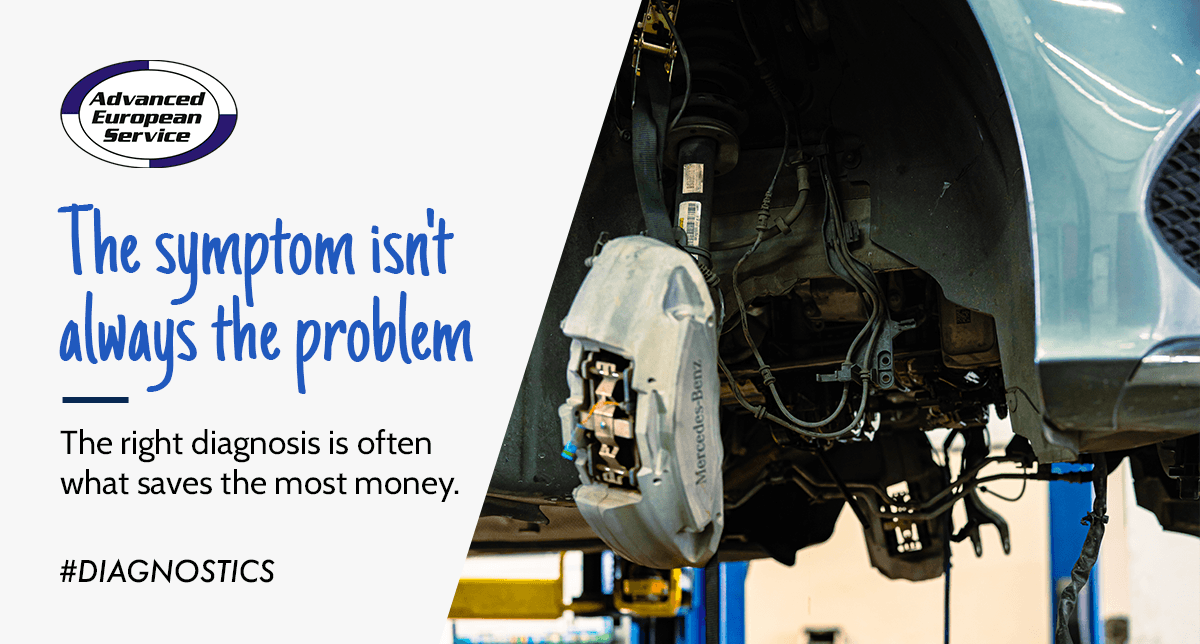
One of the most confusing experiences for vehicle owners is receiving two different diagnoses for what appears to be the same issue.
The car has one problem. How can two professionals arrive at different conclusions?
At Advanced European Service, the answer usually comes down to process.
Modern European vehicles are incredibly complex. A single symptom can have multiple potential causes. A warning light, vibration, hesitation, or unusual noise often represents the result of a problem—not necessarily the source of it.
This distinction is where diagnostic philosophy matters.
Some shops focus heavily on fault codes. Others rely on experience and pattern recognition. Some prioritize component testing, while others concentrate on live data analysis.
Each approach may identify a different piece of the puzzle.
For example, a check engine light related to fuel mixture may lead one shop to replace a sensor. Another shop may identify a vacuum leak creating the sensor reading. Both observations are technically related to the issue, but only one addresses the root cause.
The same thing happens with drivability concerns.
A vibration may be interpreted as a tire issue by one technician, while another traces it to suspension wear or drivetrain imbalance. Without a systematic diagnostic process, multiple explanations can appear equally plausible.
This doesn’t always mean one shop is incompetent and the other is correct.
It often means they approached the problem from different starting points.
The most effective diagnostics focus on verification rather than assumption. At Advanced European Service, we place significant emphasis on confirming root causes through testing, live data analysis, and real-world system behavior.
Our goal is not simply identifying a failed component.
Our goal is understanding why the component failed and whether anything else contributed to the issue.
That deeper level of analysis reduces repeat repairs and prevents unnecessary parts replacement.
Modern European vehicles communicate an incredible amount of information. The challenge is interpreting that information correctly.
That’s why diagnosis is not just about tools.
It’s about process, experience, and knowing where to look beyond the obvious symptom.