
Most drivers don’t notice power loss in a European vehicle immediately. There’s usually no dramatic moment where the car suddenly becomes slow or unresponsive. Instead, the change happens gradually. Acceleration feels slightly softer. Throttle response becomes less immediate. The vehicle still drives well enough that it’s easy to dismiss the difference as normal aging.
At Advanced European Service, we see this all the time. Owners adapt to the gradual decline without realizing how much performance has actually faded over time.
The important thing to understand is that modern European vehicles are designed to maintain their driving character for a very long time. When they begin to feel different, there is almost always a reason behind it.
One of the biggest reasons this change goes unnoticed is because modern engine management systems are extremely adaptive. BMW, Audi, Mercedes-Benz, Volkswagen, and other European manufacturers build vehicles that constantly monitor and adjust performance in real time. Fuel delivery, ignition timing, airflow, and boost pressure are continuously modified to keep the engine running smoothly and efficiently.
That adaptability is impressive, but it also masks early-stage problems.
A weak ignition coil may not create an obvious misfire at first. Carbon buildup may slowly reduce airflow over thousands of miles. A small boost leak may only affect acceleration under heavier load. The system compensates just enough to maintain drivability, even while performance quietly declines in the background.
Because the change is gradual, drivers often assume it’s normal.
But healthy European vehicles don’t gradually become dull for no reason.
Performance is the result of balance. Your engine depends on precise airflow, accurate fuel delivery, stable ignition timing, and consistent pressure control. When one part of that equation changes, the driving experience changes with it.
Turbocharged European engines are especially sensitive to these imbalances. A small issue in the intake system can affect boost response. Aging sensors can provide delayed or inaccurate data to the engine management system. Carbon accumulation on intake valves can restrict airflow enough to reduce responsiveness without triggering immediate fault codes.
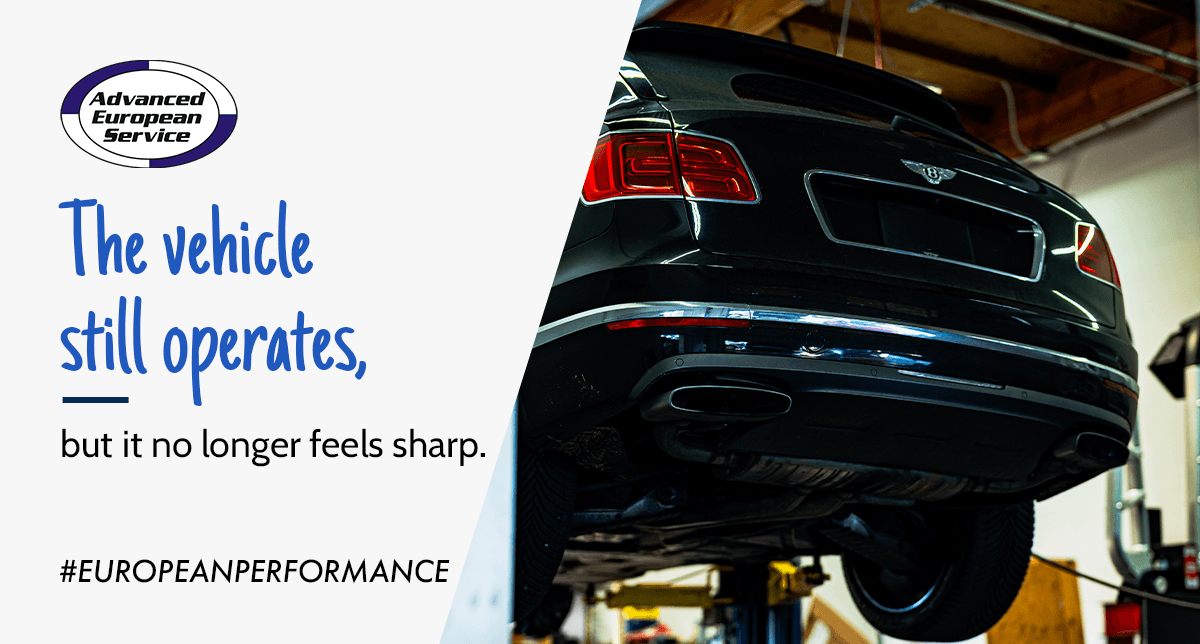
The vehicle still operates, but it no longer feels sharp.
This is where proper diagnostics become critical. At Advanced European Service, we don’t evaluate performance concerns based only on warning lights or stored codes. Many vehicles experiencing reduced performance never trigger a check engine light in the early stages.
Instead, we analyze live operating data. Fuel trim behavior, boost response, airflow readings, ignition stability, and sensor performance all provide clues about how efficiently the engine is functioning under real conditions.
Often, the difference between a vehicle that feels “normal” and one that feels properly restored comes down to identifying these smaller inefficiencies before they become larger mechanical issues.
One of the most satisfying moments for owners is driving the vehicle after the underlying issue has been corrected. Suddenly the throttle feels responsive again. Power delivery becomes smooth and immediate. The car feels lighter, sharper, and more alive.
That’s usually when they realize how much performance had gradually disappeared.
European vehicles are engineered to feel precise and effortless. When that feeling fades, it’s rarely because the car is simply “getting older.” More often, it’s because the systems responsible for maintaining that performance are no longer operating at their intended level.
The key is identifying those changes early.
Because reduced performance is often the first stage of reduced reliability — and addressing it early is what keeps a European vehicle feeling the way it was designed to feel for years to come.