
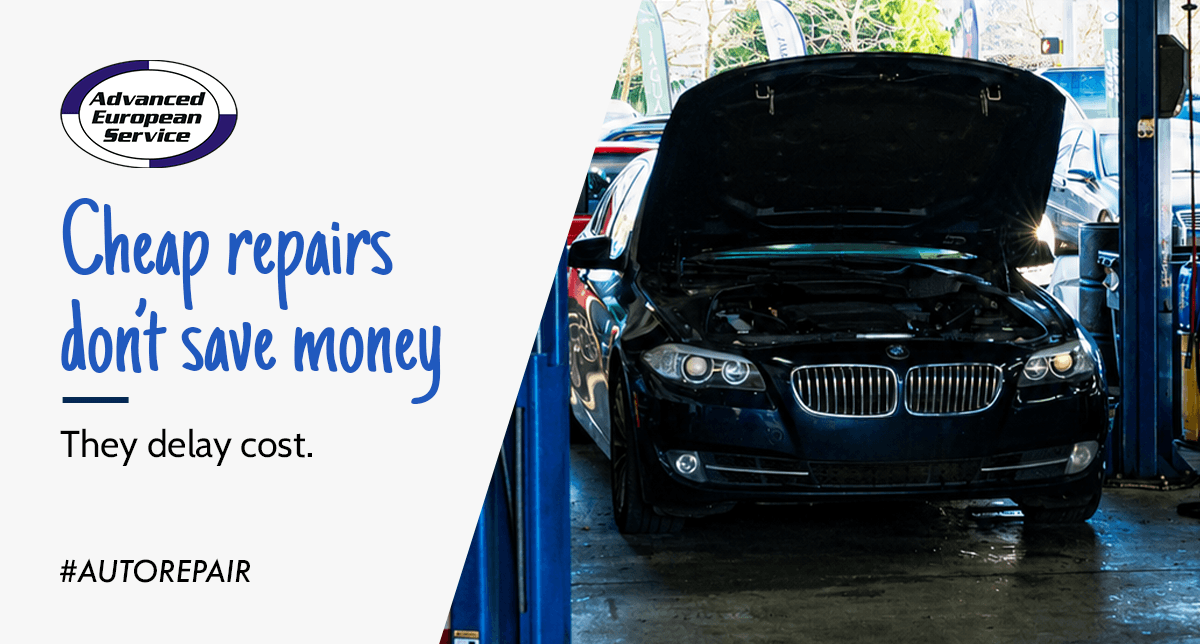
When faced with a repair, it’s natural to look for ways to reduce cost. Choosing a lower-priced part or opting for a quicker fix can seem like a smart decision in the moment.
But with European vehicles, those decisions often lead to higher costs over time.
At Advanced European Service, we see this pattern regularly — and it’s rarely about saving money in the long run.
The Nature of European Systems
European vehicles are designed as integrated systems.
Components are not isolated — they rely on each other to function correctly. This means that the quality and compatibility of one part can affect multiple systems.
When a lower-grade or incorrect part is introduced, the system doesn’t always respond as expected.
Where Cheap Repairs Fall Short
Lower-cost parts may:
- Use different materials
- Have inconsistent tolerances
- Provide inaccurate sensor readings
These differences may not be obvious immediately, but they affect how the system operates over time.
The Cost of Doing It Twice
One of the most common outcomes of cheap repairs is repeat work.
- A component fails sooner than expected.
- A system behaves inconsistently.
- Additional diagnosis is required to correct the issue.
What started as a cost-saving decision becomes a larger expense.
The Hidden Impact
Beyond direct repair costs, cheap repairs can affect:
- Performance
- Fuel efficiency
- Long-term reliability
In some cases, they also contribute to damage in related systems.
Value vs. Price
The goal of a repair is not just to fix a problem — it’s to restore the system to proper operation.
That requires:
- Correct diagnosis
- Compatible parts
- Proper installation
When all three are aligned, the repair lasts.
Final Thought
Cheap repairs are rarely about the initial price — they’re about the long-term outcome.
At Advanced European Service, we focus on getting it right the first time, because the most expensive repair is the one that has to be repeated.