
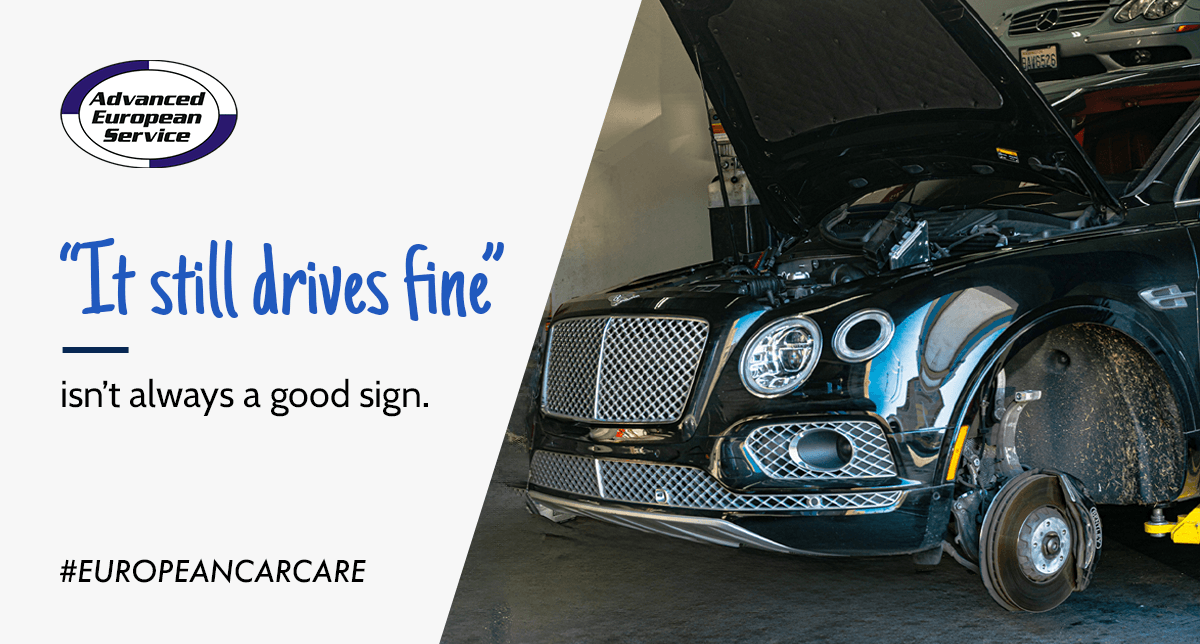
One of the most common things we hear from customers is, “It still drives fine.”
On the surface, that sounds reassuring. If the car is running, accelerating, and stopping without obvious issues, it’s easy to assume everything is under control. But in modern European vehicles, that assumption can be misleading.
At Advanced European Service, we’ve learned that “driving fine” often means the car is compensating — not that everything is functioning correctly.
Modern Vehicles Are Designed to Adapt
European cars are built with advanced control systems that constantly adjust how the vehicle operates. When something starts to go wrong, the system doesn’t immediately fail. Instead, it adapts.
Fuel delivery is adjusted. Timing is modified. Boost pressure is altered. In many cases, the car will continue to run smoothly, even as underlying issues develop.
This is why early-stage problems are often invisible to the driver.
Compensation Has Limits
While these systems are intelligent, they are not permanent solutions.
Over time, the adjustments become less effective. What begins as a minor inefficiency can evolve into a larger mechanical issue.
- A small vacuum leak might not affect drivability initially, but it can lead to fuel imbalance.
- A weak ignition component may go unnoticed at first, but it can eventually damage the catalytic converter.
- A cooling system that’s slightly underperforming can lead to overheating under load.
The vehicle doesn’t suddenly break — it gradually reaches a point where it can no longer compensate.
Why Early Detection Matters
The difference between a minor repair and a major one often comes down to timing.
When issues are addressed early, they are usually isolated and manageable. When they’re ignored, they tend to affect multiple systems.
This is why we focus heavily on early diagnosis — even when the car “feels fine.”
Listening Beyond the Drive
Drivers naturally judge their car based on feel — how it accelerates, how it sounds, how it responds.
But mechanical issues don’t always announce themselves through noticeable changes. Some of the most expensive problems begin quietly.
At Advanced European Service, we rely on data, inspection, and experience — not just how the vehicle feels in the moment.
Final Thought
“Driving fine” is not always a sign that everything is fine.
In many cases, it’s a sign that the vehicle is working harder behind the scenes to maintain normal operation.
The sooner those hidden issues are identified, the easier — and less expensive — they are to resolve.